

EU operates as one block at the climate change negotiations and takes a single greenhouse gas emission reduction target under the Paris Agreement

Bad loans continue to originate mainly from state-owned banks, where the top management's responsibility is not linked to career prospects nor has legal consequences, says Debashis Basu.
Some 800 million or more Indians gaze at their mobile phones all day. Whoever can crack what's news on the mobile phone for them and their families, for a nominal payment of Rs 10 a month, is a winner, says Ajit Balakrishnan.

PM Modi's China visit may strengthen ties between both the countries.

While churches burn in the capital and lawmakers spew rubbish, Prime Minister Narendra Modi does not think it important to utter a word against these atrocities.

The reality is that even successful Muslims are made to suffer because of their faith, and the opposition to Sania Mirza is part of the same story of discrimination, says Kashif-ul-Huda.

In the crazily complex cauldron that is India, where caste, community, class and cash are just the primary ingredients, no one has yet come up with a fool-proof method to ascertain how voters make up their minds, on which button to press, in the privacy of their 'confessional' booths, notes Krishna Prasad.


Everyone, it seems, has a question to ask the BJP's prime ministerial candidate these days. Rediff.com's Sheela Bhatt asked some well-known Indians what they would like to ask Narendra Modi, to gauge what emotions he evokes in them.

'The problem is not the performance under Vishal Sikka, but the quality of Infy's board of directors, argues Debashis Basu.

There are a couple of proposals, however, whose goals are not easily achievable.

The Budget chose to stick to an ambitious disinvestment programme for 2016-17.

We take a look at Time magazines top world leaders.

'If India maintains the Constitutional set-up that its founders envisaged -- which is that it is a parliamentary democracy, with a broadly speaking market economy, in which all people are equal as everyone votes, in which the rights of minorities are respected -- that will be a great thing.' 'Not just for India. But for humanity.'

Most television channels, including NDTV, were giving NDA a thumbs up, when it was the Grand Alliance that was winning the battle on the ground.

'Rahul is only making a pathetic public spectacle of his lack of judgment and good sense by hallucinating that somehow, the Congress, or whatever political combine is cobbled together, will displace the BJP at the coming Lok Sabha election by constantly harping on the Rafale deal,' argues retired civil servant B S Raghavan.
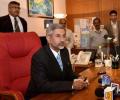
'Given his stint in Beijing, as India's longest serving ambassador there and that too through some challenging and interesting times, Jaishankar ought to have been appointed as foreign secretary in 2013 itself,' says Sanjaya Baru.

25 winters have passed. More will pass, but the fight will go on. In spite of successive governments' unwillingness to sincerely reverse ethnic cleansing of Kashmiri Hindus and provide them justice, they will steadfastly work towards securing their rights and homeland, says Lalit Koul.
Lack of decisiveness and courage to deal with PSBs may turn out be the biggest impediment to the Modi government's economic initiatives, says Debashis Basu.
.jpg)
Modi government must push reforms at a fast pace to restore growth.

The end of newspaper reporting will produce a landscape so barren that it will be terrifying, says Aakar Patel.

Neutrality and jurisdiction in international trade need to be discussed threadbare before GST is implemented in India.

As emotional beings, humans tend to be their own worst enemy when it comes to making investment decisions, says Holly Cook

Perhaps one aspect of the way modern media particularly print and news television works need some soul-searching: Their tendency to "frame" news stories as a conflict between two personalities, says Ajit Balakrishnan.

'I want to use my music to reach out to the youth, to inspire them to create history.' 'To share knowledge, to tell them the importance of voting, girl child education, menstrual hygiene.'

'The book has immense value because it reveals the inner workings of the think-tank which appears to provide facts and insights to Modi, though he himself takes the final decisions and articulates them in his characteristic rhetorical style,' says Ambassador T P Sreenivasan.
Analysts were expecting the government to propose higher capital infusion for banks.

Few readers will remember the socialist utopia of Indira Gandhi when food queues were the norm even for the middle class and tankers supplied water at odd hours of the night twice a week. Is that what you are trying to return us to, dear Congress, asks Jaideep Prabhu
Credibility of fiscal promises is a virtue that no finance minister can afford to lose.

Dr Raghuram Rajan's departure holds lessons for all, be it sections of the media, politicians or the people themselves. We need to learn how to value and retain talent. At the same time the talented must realise that talent alone does not ensure the top job, says Sanjeev Nayyar.

The strategic success of the surgical strikes has not matched their brilliant tactical achievement, says Shekhar Gupta.
'People don't want to watch a screaming channel if given a decent alternative.'

Unless the judges factor in the ungovernability of technologies and their beneficial owners, present and future Presidents, prime ministers, judges, legislators and officials handling sensitive assignments may become redundant with reference to their age-old roles for securing 'national resources and assets', warns Dr Gopal Krishna.

Analysts say that Republic TV has to hit the top spot in the shortest possible time if it has to make a dent in the ad market and break even, writes Vanita Kohli-Khandekar.

The church bells don't toll in Churachandpur any more. The hill district in Manipur has been in mourning for more than a year.
'Then all the usual troubles will break out.'

What are the most worrisome aspects of climate change for India? Can they be solved?

The time is nigh for India to ensure that investment by its former citizens is encouraged by protecting their rights, says C B Patel.
India needs to fix policy paralysis in order to reach teh top slot in solar power.
